
Yulu Product Teardown: How India's Micromobility Leader pivoted from Commuters to Gig Workers
A commuter’s perspective: I ride a Yulu almost very other day to work. It’s one of those small decisions that adds up — cheaper than an auto, faster than walking, and with zero guilt about emissions. By my count I’ve crossed easily close to more than 100 rides. Somewhere between ride 50 and 100, I stopped thinking of Yulu as a startup experiment and started thinking of it as infrastructure.
But infrastructure has to work reliably, at scale, for different kinds of people. And that’s where Yulu’s story gets interesting — because the product it built for people like me (urban daily commuters) turned out to be less commercially powerful than the product it stumbled into for a completely different user: the gig delivery worker.
This Product teardown digs into that pivot, what it reveals about Yulu’s positioning today, who its real competitors are, where it’s leaking users, and three hypothetical solutions with the metrics that would prove them right.
Market Landscape
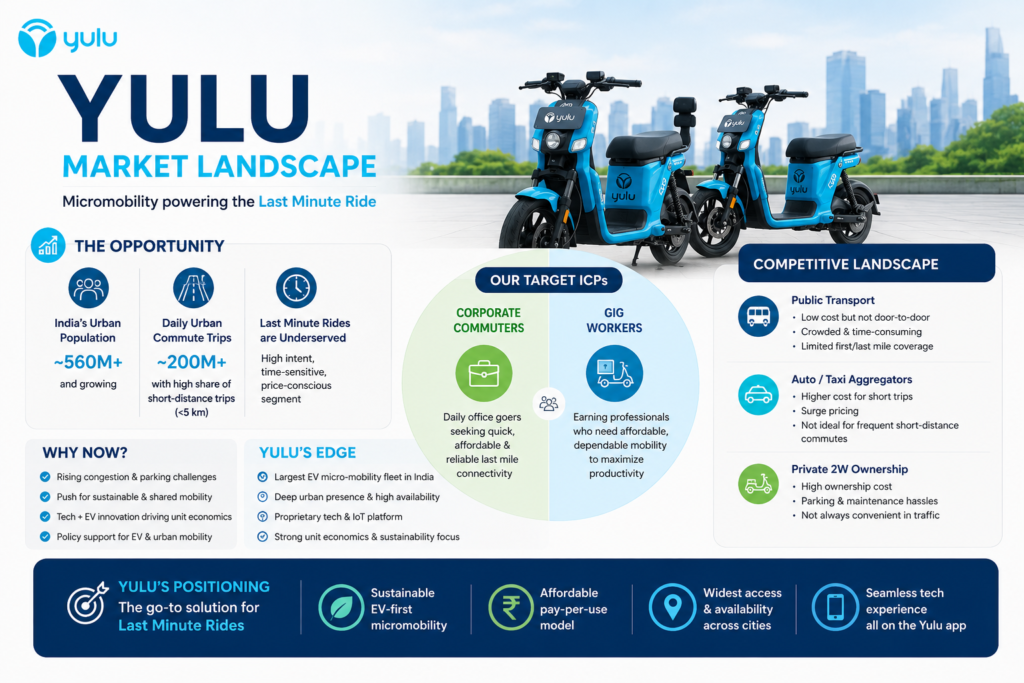
Micromobility — shared, lightweight electric vehicles for trips under 5 km — is a genuinely large category. The global micromobility market is projected to reach approximately $90.72 billion by 2026, growing at a CAGR of over 20%. India is one of its most complex theatres. Over 260 million two-wheelers are already on Indian roads, with more than half of all Indian households owning a motorcycle or scooter — which means Yulu isn’t competing against a vacuum. It’s competing against deeply ingrained ownership culture.
Products: what Yulu actually sells and who it's for
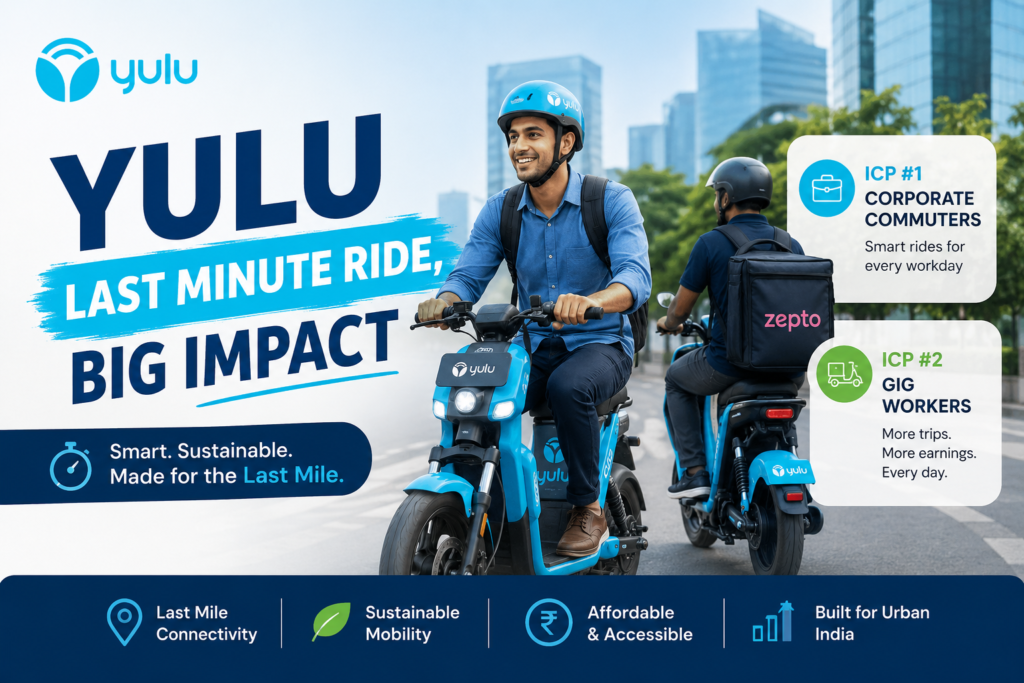
Yulu’s fleet has two distinct personalities, and understanding the split is the key to everything.
1. The first personality is the commuter-facing range — the Miracle NV and Miracle GR.
- These are light, low-speed e-bikes designed for students, office goers, and urban residents making short hops to metro stations, colleges, or markets.
- No driving licence required, 25 kmph cap.
- App-unlock via QR code.
- This range is what most people picture when they hear “Yulu.”
2. The second personality is the gig-economy range — the DeX NV and DeX GR.
- These are purpose-built delivery vehicles with a goods carrier, tail light, and mobile holder.
- They exist entirely for last-mile delivery workers on platforms like Blinkit, Swiggy Instamart, Zepto, and Zomato.
- The DeX GR, also built with Bajaj Auto, is described as India’s first electric vehicle purpose-built for delivery.
3. The Yulu Wynn XP sits in a third category
- A retail ownership product rather than a rental — and represents Yulu’s tentative step into consumer EV sales.
Here’s the crucial commercial reality: over 85–90% of Yulu’s revenue now comes from the DeX fleet, used by gig and delivery workers.
The Miracle range, which is what daily commuters like me use, accounts for less than 15% of revenue. Yulu is, in practice, a B2B gig-economy fleet operator that also runs a B2C commuter service on the side.
ICP: two very different users under one brand
Segment 1: the gig delivery worker
This is Yulu’s primary revenue driver and its clearest product-market fit. Gig workers using the DeX need a vehicle that is reliable across 8–12 hour shifts, cheap to run per kilometre, easy to maintain, and purpose-built for carrying small packages. They rent on weekly or monthly plans because daily pay-per-use economics don’t work at that intensity. Yulu has introduced flexible daily, weekly, and monthly rental plans specifically for this segment and tripled its revenue from $3.69m in FY22 to $14.34m in FY24 as a result.
Pain points for this segment: vehicle unavailability during peak hours, battery range anxiety, maintenance downtime, and rental plan rigidity.
Segment 2: the urban daily commuter (users like me)
Students, corporate workers, and residents making the same 2–5 km journey every day — to a metro station, a campus, or an office. Price sensitivity is moderate (₹2/min + ₹10 unlock is affordable for occasional use but adds up for daily riders).
The core pain points are Zone restrictions (you can only drop off at Yulu Zones, not at your actual destination), bike availability near home, and app reliability.
Critically, this segment’s decision to use Yulu is made fresh every day. Personal scooters and autos are always an alternative. There’s very little lock-in, which is why retention here is structurally difficult.
Competitive Landscape
Yulu doesn’t face a single unified competitor — it faces a different competitive set for each of its two segments.
For the gig worker segment:
Zypp Electric is the most direct rival. Zypp has built a strong presence by providing end-to-end fleet services: electric scooters, trained riders, battery swapping, and maintenance, with a fleet of 22,000+ EVs and partnerships across e-commerce and grocery delivery. Zypp’s model is more managed — they handle charging and maintenance for delivery partners, which reduces operational burden for the platforms they serve.
EVeez approaches the market differently, offering eBike subscriptions with maintenance and insurance bundled in — a cleaner proposition for gig workers who want predictable monthly costs. Alt Mobility focuses on fleet leasing to enterprise logistics players.
Yulu’s edge here is fleet scale and the DeX’s purpose-built design. No rival has a vehicle as specifically engineered for last-mile delivery as the DeX GR.
For the commuter segment:
ONN Bikes offers electric bike and motorbike rentals targeting daily commuters and enterprises with a similar app-based model. The competitive moat here is thin — the main differentiators are Zone density, bike availability, and app experience. Whoever has a Zone closest to your home wins.
The macro competitor neither rival addresses:
Personal vehicle ownership. An Indian who buys a used scooter for ₹40,000 solves the same last-mile problem permanently, with no per-minute charges and no Zone restrictions. Yulu’s real pitch has to be that the total cost of shared mobility (including zero maintenance, zero parking, and zero EMI) beats ownership — and that pitch is only compelling when the per-trip experience is genuinely frictionless.
Bottleneck analysis: where Yulu is leaking users
Bottleneck 1: Zone dependency kills the last-mile promise
The biggest structural friction in the commuter experience is that Yulu only allows drop-off at designated Yulu Zones. This made operational sense in 2018 when Yulu switched from dockless to zoned operation after bikes were being abandoned across Bengaluru. But it fundamentally breaks the product promise. If my office is 400 metres from the nearest Zone, I have to walk 400 metres anyway — which makes Yulu no better than getting off the metro one stop earlier.
Assumption: approximately 30–40% of potential daily rides are abandoned at the point of trip planning because no Zone exists within walking distance of the destination.
Bottleneck 2: commuter retention is structurally unsolved
There is no meaningful lock-in mechanism for daily commuters. No loyalty programme. No streak-based discount. No “ride 20 times this month and your 21st ride is free” nudge. Every morning, a commuter makes a fresh decision between Yulu, an auto, and walking. Yulu wins that decision based purely on Zone availability and bike condition — neither of which it can always control.
Assumption: monthly churn among commuter-segment users is likely above 40%, with most lapsed users citing “bike not available at my Zone” as the primary reason.
Bottleneck 3: the gig worker has no path to upgrade
Yulu’s DeX renters are generating 85%+ of revenue on weekly/monthly plans — but there’s no upgrade path. A high-volume delivery worker doing 80+ deliveries a day with a perfect payment record is treated the same as someone doing 10. There’s no priority vehicle access, no plan with better economics for top performers, no referral incentive. Yulu is leaving significant monetisation and loyalty value on the table within its most committed user base.
Bottleneck 4: battery infrastructure limits growth
Yulu uses battery swapping infrastructure to allow riders to replace depleted batteries at dedicated stations. But swap station density is a hard constraint on where the product works. A gig worker doing a 10-hour shift needs to know a swap station is within 3 km at all times. In cities where this network is thin, DeX utility drops sharply.
Hypothetical solutions, assumptions, and success metrics
Solution 1: flexible Zone drop — paid destination unlock
The idea: allow users to end a ride at a non-Zone location within a defined radius (say, 500 metres) for a small premium — ₹15–25 on top of the regular fare.
Why it works: it turns Yulu’s biggest friction point into a revenue stream rather than a blocker. Users who need door-to-door convenience pay slightly more. Users who are fine walking to a Zone pay the standard rate. The operational risk (bikes abandoned in bad locations) is managed by the premium pricing acting as a behavioural filter.
Assumptions: 20% of rides would upgrade to flexible drop if the option existed. Average premium of ₹20 per flexible ride. No material increase in bike recovery costs if the flexible radius is tightly defined.
Success metrics to track: flexible drop adoption rate (target: 15–25% of rides within 60 days of launch), revenue per ride uplift (target: +₹4 average across all rides), change in churn rate among users who use flexible drop vs those who don’t (proxy for retention impact).
Solution 2: commuter loyalty programme — “Yulu Miles”
The idea: a simple streak-and-reward system. Ride 5 days in a week, get 10% off the following week. Ride 20 days in a month, get two free unlock credits. Refer a friend who completes 10 rides, get ₹100 ride credit.
Why it works: the commuter segment’s weakness is zero lock-in. A points system that resets if you skip a week creates a mild but real switching cost — not because Yulu becomes dramatically better, but because leaving means losing accumulated progress. This is the same psychology behind Duolingo streaks applied to mobility.
Assumptions: 25% of monthly active commuters would engage with the loyalty mechanic. Engaged users ride 1.8x more frequently than non-engaged users (based on typical loyalty programme lift in consumer apps). Programme cost is offset if engaged users ride at least 3 additional rides per month.
Success metrics: weekly active commuter rides per user (baseline vs. programme cohort), streak completion rate (% of users completing a 5-day streak), month-2 retention rate for loyalty programme users vs. control group.
Solution 3: DeX Pro tier — fleet upgrade for power delivery partners
The idea: a tiered plan for high-volume DeX renters. Standard plan stays as-is. DeX Pro (₹500–700/month premium) unlocks: priority vehicle reservation for peak hours (7–9 AM, 6–8 PM), faster battery swap queue at partner stations, maintenance priority (next-day swap if your vehicle has an issue), and a monthly performance bonus (₹200 credit for top 10% of riders by delivery count).
Why it works: Yulu’s highest-value users, delivery workers doing 60+ deliveries a day — are currently indistinguishable from casual renters in the system. A Pro tier creates a premium segment, improves vehicle reliability for Yulu’s best customers, and gives Zomato/Swiggy/Blinkit a reason to preferentially recommend Yulu to their high-performing delivery partners.
Assumptions: 10–15% of existing DeX renters would upgrade to Pro. Pro users have 30% lower churn than standard renters due to investment in the tier. Partner platforms would co-promote the tier as a way to improve delivery reliability on their side.
Success metrics: Pro tier adoption rate, DeX Pro churn rate vs. standard (target: 25% lower), revenue per DeX user uplift, Net Promoter Score among Pro users vs. standard, and inbound referrals from delivery platform partners.
Positioning: the tension Yulu needs to resolve
Yulu’s current positioning carries an unresolved tension. Its marketing, its app, and its commuter products speak to an aspirational sustainable urban mobility story — “clean, green, affordable rides for everyone.” But its revenue reality!!! is a B2B gig fleet business where 85% of money comes from delivery workers, not commuters.
This isn’t necessarily a problem — many companies discover their real market is different from their intended one and build around it. But Yulu hasn’t fully committed to either positioning. The commuter brand identity creates expectations the commuter experience doesn’t always meet. And the gig fleet business doesn’t yet have the premium B2B positioning that would let Yulu charge more from the platforms that depend on it.
The sharpest version of Yulu’s positioning would be something like: “The operating system for urban last-mile mobility in India.” That framing holds together the delivery fleet (Yulu as logistics infrastructure), the commuter product (Yulu as daily transport infrastructure), and the battery-swap network (Yulu as energy infrastructure) under one coherent identity — and gives investors, platform partners, and city authorities a consistent story to engage with.
Closing thought
The most important thing I’ve noticed across my 100+ rides isn’t the product. It’s the habit. Yulu doesn’t need to be perfect every day, it needs to be present every day. When the bike is there, it’s an easy yes. When the Zone is too far, it’s an easy no.
That’s both the vulnerability and the opportunity. The company that solves Zone density and daily rider retention will own urban commuter mobility in India for the next decade. Yulu is the best-positioned to do it. It just has to decide that commuters matter as much as the delivery figures suggest they don’t.
This article is part of the MarketingPsyche product teardown series, first-person analysis of Indian products, brand strategy, and marketing decisions.