What is a Product-led Growth Model?
A product can be adopted by users in various ways, strategies, models, and approaches. One such model is the Product-Led Growth (PLG) model, where the product itself drives growth, without relying heavily on marketing efforts or sales representatives.
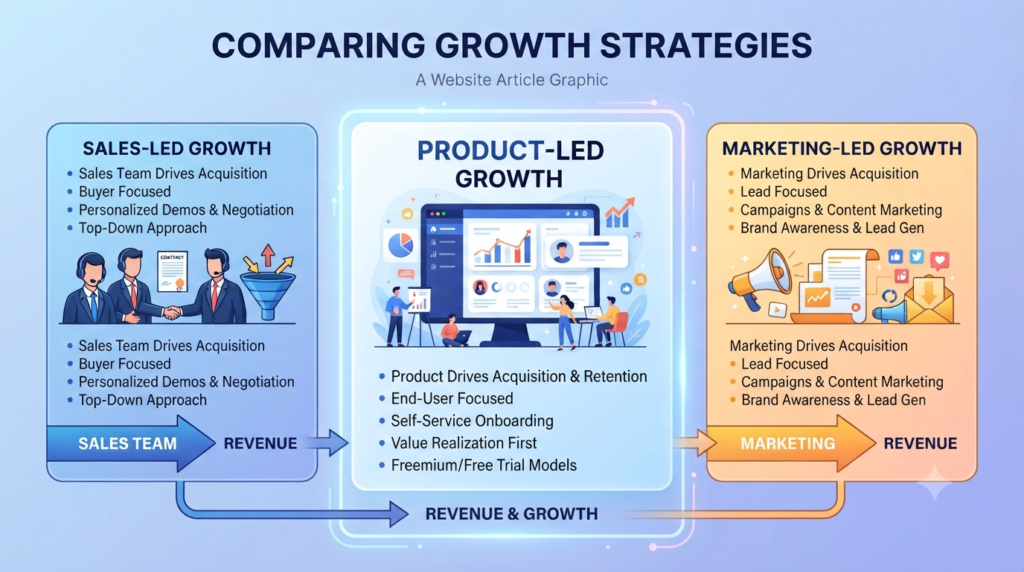
There are different ways in which a product gets adopted in the market:
1) Product-Led Growth (PLG)
2) Marketing-Led Growth (MLG)
3) Sales-Led Growth (SLG)
Product-Led Growth refers to a product’s growth and adoption being primarily driven by the product itself. This happens through the product’s features, differentiators, and unique value proposition. In a Product-Led Growth model, there is minimal intervention from external factors such as marketing campaigns or sales communications.
A Product-Led Growth strategy attracts users based on the value the product delivers and its adoption mechanisms, such as freemium models, free trials, viral loops, seamless onboarding, referrals, and much more.
What Makes Product-Led Growth Successful?
A Product-Led Growth model relies heavily on the product to create value and drive adoption. There is no heavy marketing influence to persuade customers, nor is there a dedicated sales force building relationships to close deals. The product itself becomes the primary driver of growth.
Companies achieve Product-Led Growth through various approaches, such as:
1) Using a Freemium Model or Free Trial
A freemium model gives users and potential customers the opportunity to try the product, experience its value firsthand, and then decide whether they want to continue using it through a paid plan.
2) Referral Programs and Rewards
Referral programs allow satisfied customers to recommend the product to their friends, colleagues, and networks. In return, they receive rewards, credits, discounts, or other incentives. This creates a self-sustaining growth loop.
3) Seamless Onboarding and Self Sign-Ups
Product-Led Growth often relies on a frictionless onboarding process where users can sign up, explore the product, and begin realizing value with minimal effort and resistance.
4) Self-Sustaining Product Features
Certain features naturally encourage product adoption and engagement, making it easier for users to discover value without requiring extensive support or intervention.
5) Product-Led Growth Metrics
Some of the most important Product-Led Growth metrics include:
– Time to Value (TTV)
– Conversion Rate to Paid Plans
– Referral Rate
– Churn Rate
– Monthly Active Users (MAU)
– Weekly Active Users (WAU)
Top Companies That Adopted a Product-Led Growth Model
Slack: Slack is one of the most widely cited examples of Product-Led Growth. Founded in 2013, Slack transformed the way teams communicate and collaborate in professional environments. Instead of relying primarily on aggressive sales efforts, Slack encouraged users to try the product through a freemium model and a seamless onboarding experience. Teams could easily adopt Slack, experience its value, and gradually expand its usage across their organizations. The product’s ease of use and collaborative features helped it grow rapidly, making it a strong example of Product-Led Growth in action.
Grammarly: Grammarly is another SaaS company that has successfully scaled through a Product-Led Growth strategy. Its freemium model allows users to instantly check documents for grammatical errors and writing improvements. One of Grammarly’s biggest strengths is its ease of access and seamless integrations across browsers, Google Workspace, Microsoft Office, Android devices, and other platforms. Users experience value immediately, which encourages continued adoption and upgrades to premium plans.
ChatGPT: In the age of AI, it is difficult to find someone who has not heard of ChatGPT. A major reason for its widespread adoption is that millions of users have been able to experience its capabilities through a free tier. People use ChatGPT to generate content, create images, draft emails, brainstorm ideas, and solve problems. Once users experience its value, they often continue using it regularly. ChatGPT relies heavily on Product-Led Growth principles, including a freemium model, seamless onboarding, immediate value delivery, and strong user engagement.
All of the examples above point to one important idea: great products often drive their own growth. They engage users, create value, encourage repeated usage, and improve customer retention.
Unlike traditional growth models, which focus on creating awareness, generating leads, nurturing prospects, and driving conversions, the Product-Led Growth model places the product at the center of the customer journey.
The product itself becomes the primary growth engine.
The examples above demonstrate that an outstanding product, combined with a ready market, can achieve remarkable growth. Rather than relying solely on traditional marketing and sales practices, a strong product can create demand, drive adoption, and generate growth through the value it delivers to users.