
HubSpot's Messy Positioning: A Product Teardown
What is HubSpot?
HubSpot started as a simple inbound marketing tool and has grown into a full CRM platform built around five separate “hubs”: Marketing, Sales, Service, CMS, and Operations. Each hub can be bought on its own or bundled together as the “Customer Platform,” and each carries its own Free, Starter, Professional, and Enterprise tiers.
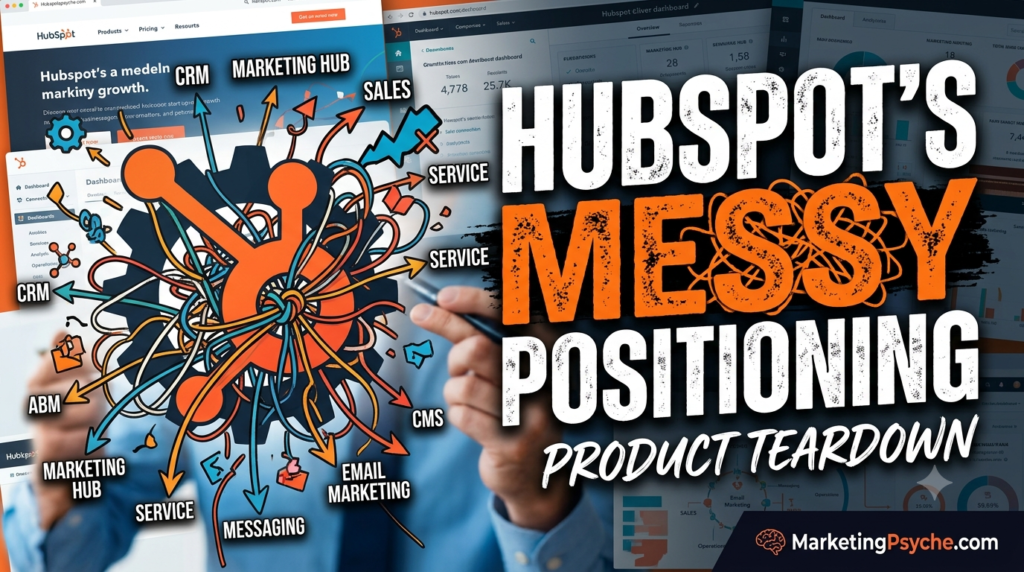
That growth is the problem. What began as one clear product has turned into a positioning puzzle that even experienced buyers struggle to solve.
Market Size
HubSpot competes in the CRM and marketing-automation software market, going up against Salesforce, Zoho, and Freshworks. It’s a crowded, fast-growing category where switching costs are high and the first buying decision — which platform, which tier, which hub — sets the trajectory of the entire customer relationship. Small missteps in that first decision translate directly into abandoned trials and stalled deals.
Pricing & Tiers
Starter: $20/seat/month (month-to-month) or $15/seat/month (annual), one seat unlocks Marketing, Sales, Service, Content, Data Hub, and Commerce Hub together
Sales Hub Professional: from $100/month (1 seat included, $100/extra seat, $50/core seat) → Enterprise: from $150/month ($150/extra seat, $75/core seat)
Marketing Hub Professional: $3,000 one-time onboarding → Enterprise: $7,000 one-time onboarding
Sales/Service Hub Professional: $1,500 onboarding each → Enterprise: $3,500 onboarding each
Customer Platform: bundles all hubs at a matched tier for a discount versus buying separately
Four tiers, five hubs, two pricing logics (per-seat vs. per-hub flat fee), plus a bundle that changes the math again. That’s the raw material of the confusion.
Lorem ipsum dolor sit amet, consectetur adipiscing elit. Ut elit tellus, luctus nec ullamcorper mattis, pulvinar dapibus leo.
Problem Diagnosis
A. Product Tier Confusion. Starter prices per seat; Professional and Enterprise price per hub, with a separate one-time onboarding fee stacked on top. A buyer evaluating “Marketing Hub Professional” and “Sales Hub Professional” is silently comparing two different pricing models without realizing it. Nobody can say with confidence what unlocks real value or when to upgrade.
B. ICP Blurring. HubSpot serves SMBs, mid-market, and enterprise at once, but the messaging doesn’t sharply separate them. A solo founder and a 2,000-person revenue org land on largely the same pages, reading largely the same pitch.
C. Value Narrative Fragmentation. Each hub tells its own story — Marketing talks campaigns, Sales talks pipeline, Service talks support — with no unifying answer to “why HubSpot as a platform?” The shared CRM data model, HubSpot’s actual structural advantage over point tools, rarely leads the pitch.
D. Entry Point Friction. New evaluators consistently stall on the same three questions: Do I start with CRM? Marketing Hub first? Why not just use something simpler? Without a default path, the decision fatigue happens before the product ever gets evaluated on its merits.
Recommended Repositioning
1. Collapse the tier story to one axis. Lead with three platform-wide tiers — Starter, Professional, Enterprise — that apply across every hub at once. Make hub selection a secondary, needs-based add-on decision, not a second parallel pricing decision. The bundled Customer Platform becomes the default quote; single-hub pricing becomes the exception path, not the front door.
2. Segment messaging by ICP, not by hub.
- SMB: “One login, everything included, priced per seat” — sell speed and simplicity
- Mid-market: “Replace four point tools with one connected system” — sell consolidation and ROI
- Enterprise: “One customer data model across marketing, sales, and service” — sell governance and reporting
Each segment gets its own landing page, deck, and case studies, with hub features as supporting proof rather than the headline.
3. Replace the hub-first narrative with a platform-first one. The real differentiator is that every hub writes to the same contact, company, and deal record. The pitch should be “your customer data compounds in value as you add hubs” — not “five products that happen to share a login.”
4. Fix the entry point with one default path. Start every evaluation with free CRM plus Starter — one seat, all hubs included. Prove value in 30–60 days, then upgrade whichever hub is creating friction. That removes “which hub first?” from the buyer’s plate entirely.
Expected Impact
- Fewer stalled deals at the “which hub / which tier” evaluation stage
- Shorter sales cycles for SMB and mid-market through a single default entry path
- Higher hub attach rate after Starter, since the upsell path is pre-defined instead of re-negotiated deal by deal
- Clearer differentiation from Salesforce (an assembled platform) and Zoho/Freshworks (cheap point tools) around “one data model, one price axis”